




We watched the first episode of Webflow's View Source livestream live on October 27, 2026, when three people from Webflow demoed the preview for about 43 minutes. What struck us most was how different Source is from the current Webflow platform: a new direction for what comes next at Webflow, much bigger than an extra feature. This post pairs what they showed and said with Webflow's written announcements, and each quote links to its moment in the recording. We build Webflow sites for B2B companies, and headless sites on Astro and Next.js with Sanity, so we have an interest in the topic.
What is Webflow Source?
Source by Webflow is a separate platform from the Webflow Designer, which Webflow announced on September 2, 2026, at Webflow Conf in Boston. Source connects to a site's existing codebase, CMS, and marketing tools, and lets people and AI agents change that code from a visual canvas, a chat with an agent, or a code editor, under shared rules.
Webflow's own one-line definition calls it "a new platform for modern marketing teams and their AI agents to launch, optimize, and scale digital experiences, together."
Webflow laid out its reasoning in a July 2026 engineering post, Getting to the source, by chief product officer Ben Haefele and Utkarsh Sengar, vice president of engineering. Today's Webflow keeps your site in its own data format and compiles HTML, CSS, and JavaScript from it. Any system with two versions of the truth drifts, they argued, and coding agents now make code workable for people who don't write it. Their summary: "What you design and what ships should be the same thing."
On the livestream, Katherine Grygo, a product manager on Source, described the problem from the marketing side. AI has made the first build fast, she said, but teams still lack shared context, governance, and flexible interfaces for the work after launch, and "a prompt box isn't always the most effective way to build." With the codebase as the source of truth, she added, agents can take on bigger changes "without an abstraction layer holding them back."
Source has its own vocabulary, which Grygo walked through at 5:35. A workspace holds your people, tools, and work. A project is built around a goal and a brief, and projects can nest, so a brand's campaigns can live inside it. A session is where you work with an agent and watch what it produces. A view is a screen shaped around one job, assembled from blocks that come from Webflow, partners, or your own team. Webflow's press release puts it as giving each marketing team member and their agents a governed workspace built around their role.
Webflow's product page lists default views such as Inbox, Review, Audit, Brand, CMS, and Agents. The October demo showed Site, Content, Brand System, and Agents views, plus custom ones, so the set is still moving.
The AI agents also work between requests. In Webflow's launch post, one agent flags and drafts AEO fixes that wait in the Source Inbox for a growth marketer, another spots pages losing conversions and suggests variants, and a third checks brand voice before launch. The press release says agents monitor site and campaign performance and bring recommendations for review.
All of it runs under what Webflow calls governance: brand systems, role-based access, approval paths, and audit trails. Teams choose how much autonomy agents get and can require human approval before changes ship. Agents work under the same permissions as people, and every change is logged with the person or agent who made it.
How is Source different from the Webflow you use today?
The Webflow you use today stores your site in its own format and generates the code for you. Source starts from code: in the October 2026 demo it opened an Astro project, and Webflow says Astro and Next.js are the options out of the box. Webflow's current platform keeps running alongside it.
| Webflow today | Source by Webflow | |
|---|---|---|
| What the site is | Data in Webflow's own format, compiled to code by Webflow | The code itself, in an Astro or Next.js project |
| Where you work | The Webflow Designer, in a browser | A project folder on your computer, or a cloud session on a GitHub repo |
| How edits go live | Publish to Webflow hosting | Commit to a GitHub branch, then deploy to Webflow Cloud |
| Where content lives | Webflow CMS | Your current source, such as Astro content collections, Sanity, or Shopify; Webflow's next-gen CMS is on the way |
| What agents do | Work through Webflow's AI features and its MCP server | Built-in and custom agents run in sessions and views, with skills |
| Availability | Generally available | Limited research preview |
In Source, a visual edit on the canvas and an agent's change both write to the same underlying code, which Webflow describes as building "agentically or visually, on the same surface." Trade press framed Source as Webflow's answer to agentic coding tools such as Claude Code, Cursor, and Codex, with marketing teams as the users (diginomica).
The current platform keeps getting agent features too. At Webflow Conf 2026, Webflow announced MCP 2.1, Agent Presence, and AEO content agents for it, and the Source FAQ says Webflow will keep investing in the current platform, agentic features included. If you want agents on a Webflow site now, our post on what Webflow MCP can change on a live marketing site covers what we would allow.
What did Webflow show in the first View Source livestream?
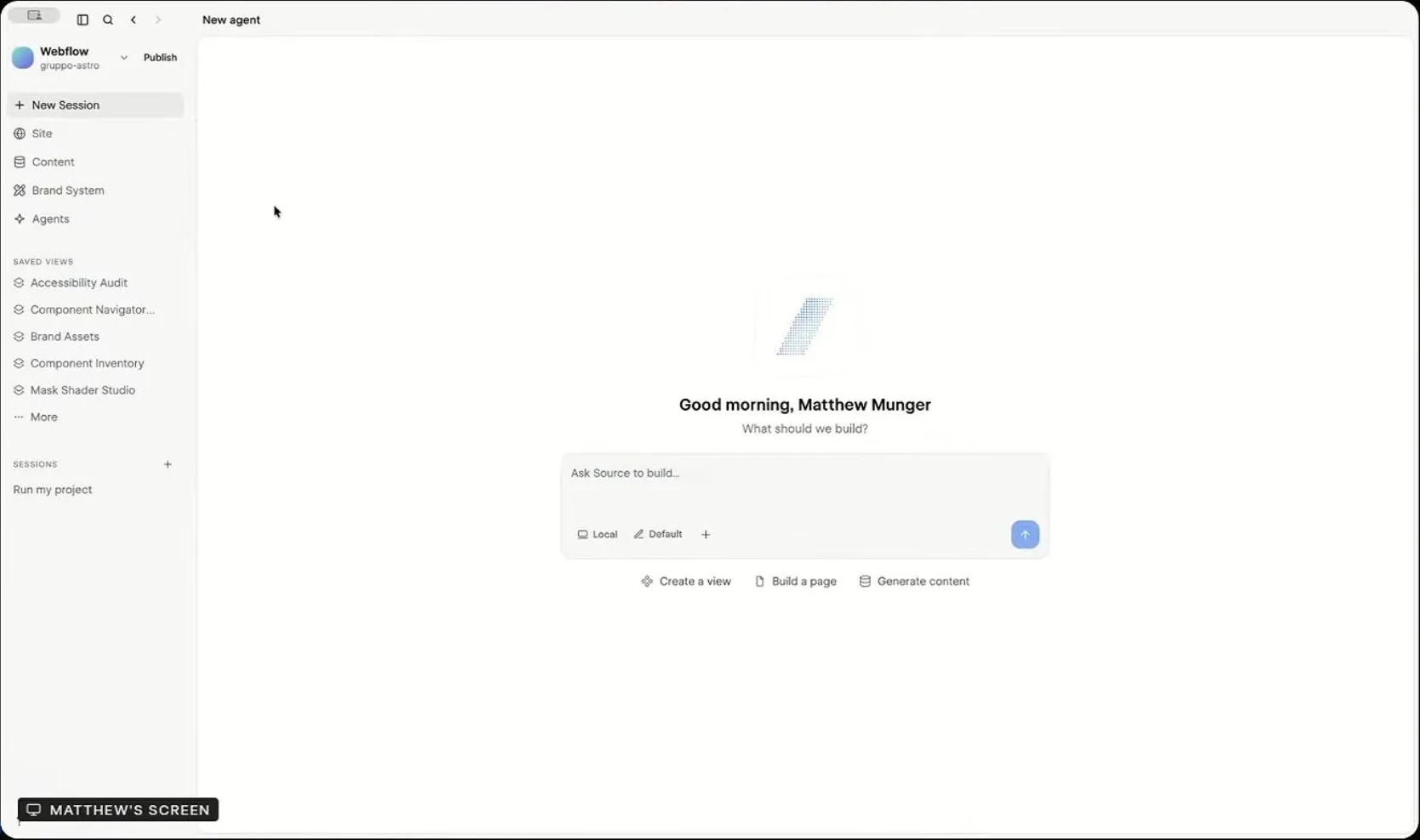
In the first View Source episode on October 27, 2026, Webflow's Matthew Munger, Timothy Ricks, and Katherine Grygo ran the Source by Webflow research preview live on a demo site for planning company retreats, built in Astro. Most of the 43 minutes went to views: the built-in ones and custom views the team built for audits, components, icons, and graphics.
| Time | What they showed | Why it matters |
|---|---|---|
| 9:15 | The start screen: open an Astro or Next.js folder on your computer, or connect a GitHub repo for a cloud session | Source works on code where it already lives |
| 13:39 | A Brand System view that reads color, type, spacing, sizing, and shape tokens from a design.md file in the project | Brand rules become a file that people and agents share |
| 17:15 | Visual edits on the canvas stay pending until someone picks "apply and commit" | Nothing reaches the code until a person approves it |
| 18:16 | Code mode: switching a button variant in index.astro, with "no agent involved" | Small edits don't need a prompt |
| 23:03 | An accessibility audit view built with the Source CLI, using Codex and Claude Code. It scanned 104 pages and found 56 heading issues | Teams can build their own tools inside Source |
| 25:56 | A component inventory that shows where each component is used, and which ones nothing uses | A cleanup list before a redesign |
| 28:44 | An icon builder that saves new icons straight into the project, with access set per view | Internal tools without a password-protected page |
| 39:10 | What shipped that week: shared cloud environments, GitHub branch publishing with Webflow Cloud deploys, and a view builder agent | The preview changes from release to release |
Two caveats came from the presenters themselves. Munger, who hosted, called the site view "really early designs," and said each episode will show a different part of Source as the team builds it. Treat every screen in the stream as a snapshot of a product in progress.
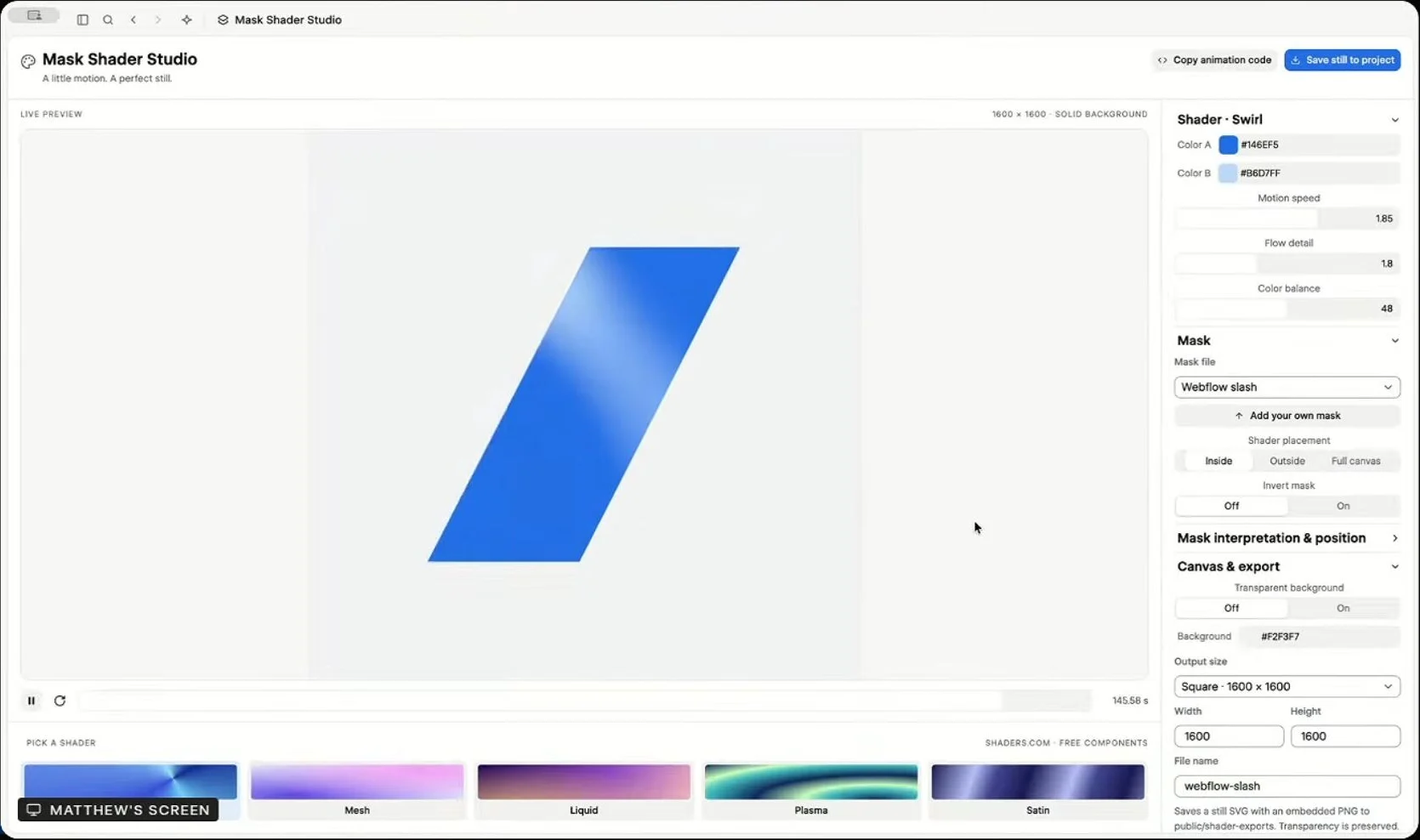
Ricks also showed a component navigator he built as an editor for Astro projects, with props, section variants, Git history, and a full-page code view. Munger showed a shader studio that saves animated logo stills into the project's public folder. Grygo pointed to the marketing case: a custom view can pull in tools a team already uses, such as Asana, Google Drive, or Notion, instead of a "Frankenstack" of tabs.
What happens to your existing Webflow site?
Nothing, unless you choose to move. Webflow says its current platform isn't going anywhere and that it will provide a supported migration path when Source is ready. On the stream, Timothy Ricks added the detail that matters: a Webflow site that moves into Source gets converted to a codebase such as Next.js or Astro.
"There will be a path to bring your website over into Source, your existing Webflow site, but at that point it would be converted over to a codebase like Next.js or Astro," Ricks, a senior technical evangelist at Webflow, said in answer to a viewer's question (37:54). He gave the reason in the same answer: on those frameworks, "AI agents can work with them, understand them really well."
Webflow's July post made the same promise in other words: "We're building the bridge before we ask anyone to cross it." No date or method for that bridge has been published. The demo site had already crossed one bridge of its own: Ricks said it was first built in Next.js and that Source rebuilt it in Astro with the team's design system and components (21:31).
For a team on Webflow, the conversion is the part to plan for. On a codebase, things the Designer handles for you, like forms, site search, and how CMS content is stored, become decisions in code. We covered those pieces in what happens to forms, search, and CMS content when a site leaves Webflow. Webflow hasn't said how much of that work its migration path will do for you.
How much will Webflow Source cost?
Webflow hasn't published prices. On October 27, 2026, product manager Katherine Grygo said Source pricing will likely combine a platform fee with usage-based AI credits, so the bill depends on how much you use agents, and that existing Webflow plan prices won't change.
"Directionally, we expect Source pricing to include a platform fee and usage-based AI credits like the ones we already provide today," Grygo said (35:17), adding that "what customers pay will depend on how they configure and use agents." Munger said Webflow wants to learn where the value is with preview users before it sets prices. The product page lists no Source pricing as of October 28, 2026.
Until numbers exist, the useful planning question is volume. How many agent sessions, audits, and content changes would your team run in a month? That's the part of the bill that will move.
When will Source be available, and how do you get access?
There is no general availability date. Source is in a limited research preview, and Webflow is enrolling select agency partners and customers in phases; you apply through the form at webflow.com/source. On the stream, Webflow said each release of the preview brings in more people.
"We don't have a general availability date to share just quite yet," Grygo said (36:23). The product page still describes enrollment "in a phased approach over the coming months." We applied for the research preview in early October 2026.
The research preview has moved quickly since Webflow Conf. In the week of the stream, Webflow shipped three things (39:10):
- Shared cloud environments, so a team can work on the same GitHub-connected codebase without setting up local development.
- Publishing changes to a GitHub branch, then deploying to Webflow Cloud when you're ready to go live.
- A view builder agent that builds a view from a question such as "what's happening with conversions on this page," which you keep if it helps.
Next on the roadmap (40:13) are sharing private custom views with teammates, more specialized agents for site, content, and brand-system work, and the first version of Webflow's next-gen agentic CMS inside Source, with collections, CMS items, and reusable CMS blocks such as a hero or a call to action.
Which frameworks, CMS platforms, and AI tools does Source work with?
Today, Source works on Astro and Next.js projects, opened from a folder on your computer or from a GitHub repo in the cloud, and it can deploy through GitHub to Webflow Cloud. Content can come from Astro content collections, Sanity, or Shopify. Webflow plans to let you connect your own AI assistant and developer tools.
"This could be an Astro project. It could be Next.js. Those are kind of the options out of the box today," Munger said as he opened the demo site (9:23). Source scanned the folder, recognized the framework, and launched a live preview. The content view can read from Sanity or Shopify product collections, and in the demo it read Astro content collections straight from local files (12:39). Webflow's own next-gen agentic CMS is saved for a future episode. So Source isn't a headless CMS itself: it reads content from the CMS platforms you already use, and the agentic CMS is what will add collections, CMS items, and CMS blocks inside Source.
On AI tools, Munger said he built the accessibility view with the Source CLI using both Codex and Claude Code, and that the site builder agent can build views too (23:11). Asked whether you can connect your own models, he said the plan is to let you connect Source to "your AI assistant of choice and the dev tools you already use" (36:52). In September 2026, Haefele told CMSWire that models from Anthropic and OpenAI "are a core part of what powers Source."
Extensions are the layer where Webflow, partners, and customers add views, blocks, tools, agents, and skills (7:38). Webflow hasn't published documentation for them yet.
Astro and Next.js are the frameworks we build headless sites on, and our own site runs on Astro and Sanity. If you're weighing that stack for reasons beyond Source, see how to choose a CMS for an Astro site or our headless CMS development services for Next.js and Astro.
Should marketing teams wait for Source or keep building on Webflow?
Keep building. Source has no launch date or price, Webflow calls its site view early, and a Webflow site that moves later becomes a Next.js or Astro codebase anyway. What you can do now is get your brand rules, components, and content model into shape, because the October demo showed Source reading each of them.
Brand rules come first. The Brand System view in the demo read tokens from a design.md file, and Webflow lists brand systems among the guardrails agents work within. A team with its colors, type scale, and voice written down can hand that file to any agent, in Source or anywhere else.
Components come next. Munger's component inventory sorted components by use and surfaced the ones nothing used, which he read as either dead code or a sign that people and agents weren't building pages from components (25:56). A Webflow site with a tidy component library will be easier to convert, whatever does the converting.
Then the content model. Collections with clear, typed fields map onto a CMS view and onto code more easily than collections that keep everything in one rich text field. And settle who approves what: Webflow says teams can require a person to sign off on agent changes before they reach the live site, which only helps if you've named that person.
If you have developers and an Astro or Next.js codebase, apply at webflow.com/source and test the preview on a copy of a real project. If you're on Webflow and mid-project, finish the project. And if you're weighing a move off Webflow for reasons of your own, our guide on when to leave Webflow for custom code covers the trade-offs, with or without Source.
Questions about Webflow Source
Is it called Webflow Source or Source by Webflow?
The official name is Source by Webflow. Most people search for Webflow Source, and some write Webflow by Source. All three mean the same platform, which Webflow announced on September 2, 2026.
Is Webflow Source free?
No price has been announced. On October 27, 2026, Webflow said it expects Source pricing to combine a platform fee with usage-based AI credits, and that existing Webflow plan prices won't change.
Does Source replace the Webflow Designer?
Not for now. Webflow says its current platform isn't going anywhere and that it keeps investing in it. Source is a separate platform, and moving to it is optional.
Do I need to know how to code to use Source?
Not for every task. In Webflow's October 2026 demo, people changed the site through a visual canvas, an agent, or the code. A project still starts from an Astro or Next.js codebase, so someone on the team needs to own that code.
Is Source a headless CMS?
No. Source reads content from the CMS you already use, such as Astro content collections, Sanity, or Shopify. Webflow plans to bring its next-gen agentic CMS into Source, with collections, CMS items, and reusable CMS blocks.
Is Source a desktop app?
It can work on a project folder on your own computer, as Webflow showed in its October 27, 2026 demo, and it can also run cloud sessions on a GitHub repo. Trade press described it as a desktop application at launch.
Sources
- Webflow: Source by Webflow (product page and FAQ) Accessed October 28, 2026
- Webflow on YouTube: View Source, Building with the Source research preview (October 27, 2026) Accessed October 28, 2026
- Webflow: Introducing Source by Webflow, where marketers and agents run the web Accessed October 27, 2026
- Webflow: Getting to the source Accessed October 27, 2026
- Webflow: The biggest announcements from Webflow Conf 2026 Accessed October 27, 2026
- Webflow (GlobeNewswire, via Yahoo Finance): Webflow unveils agentic platform, Source by Webflow Accessed October 27, 2026
- CMSWire: Why Webflow faces a pivotal moment in its digital experience evolution Accessed October 27, 2026
- diginomica: A new workspace for marketing, Webflow takes on agentic IDEs with Source Accessed October 27, 2026