A security questionnaire is a set of questions a buyer sends a vendor to check how it protects data, controls access, and handles incidents before signing. This guide covers the standard formats, what they ask, including about your marketing website, and how B2B SaaS teams can answer them faster, as of October 2026.
What is a security questionnaire?
A security questionnaire is a structured list of questions that a company sends a vendor to check its security and privacy controls, before a contract and often at renewal. The answers are self-reported, so buyers usually ask for evidence as well, such as a SOC 2 report, an ISO/IEC 27001 certificate, or a penetration test summary.
You will hear it called a vendor security questionnaire, a security assessment questionnaire, a vendor risk assessment questionnaire, or simply a security review. From the buyer's side it is one step in third-party risk management. From your side, as the SaaS vendor, it is a step between a verbal yes and a signed contract.
Buyers don't invent this step. Control 15 of the Center for Internet Security's 18 Critical Security Controls, Service Provider Management, opens with: "Develop a process to evaluate service providers who hold sensitive data." NIST's quick-start guide on supply chain risk, published in October 2024, tells organizations to scale supplier requirements to each supplier's criticality and to require evidence of sound security practices, such as self-attestation, conformance to known standards, certifications, or inspections. A questionnaire is the self-attestation.
An audit report is different. A SOC 2 report is a CPA's examination of a service organization's controls relevant to security, availability, processing integrity, confidentiality, or privacy, and the AICPA notes that "customers and business partners often request" one. The questionnaire asks; the report attests.
Why do buyers send security questionnaires?
Because vendors are a common way in. In Verizon's 2026 Data Breach Investigations Report, released May 19, 2026, breaches with third-party involvement rose 60% from the previous dataset and reached 48% of all breaches. A questionnaire is the buyer's first check that your company will not become the way in.
The report draws on more than 31,000 security incidents, over 22,000 of them confirmed breaches, so the third-party figure is not a niche finding.
For the vendor, a questionnaire is a sales problem as much as a security one. In G2's buyer research published July 22, 2026, based on more than 1,000 B2B software buyers, IT security review was the single biggest source of delay in software purchases. 39% of buyers named it, and so did 50% of enterprise buyers. A questionnaire that sits in someone's inbox for two weeks stalls the deal for two weeks. For the rest of what buyers check before a sales call, see what B2B software buyers need from your website.
What are the standard security questionnaire formats?
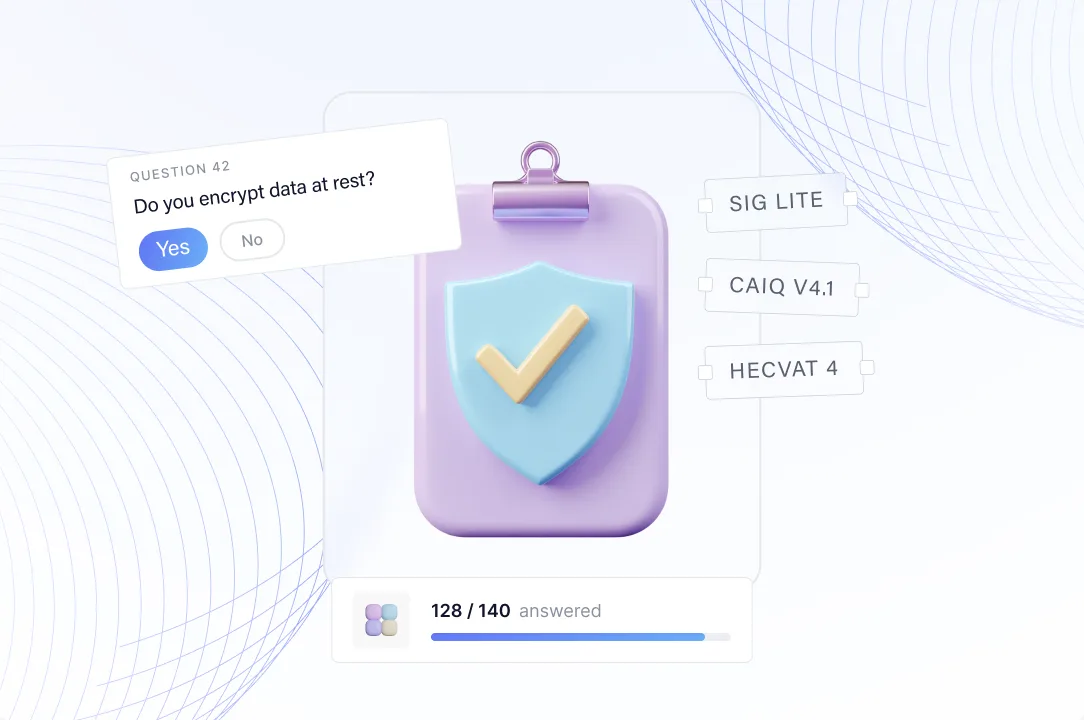
Most questionnaires are either an industry standard, such as the Shared Assessments SIG, the Cloud Security Alliance CAIQ, or EDUCAUSE's HECVAT, or the buyer's own list in a spreadsheet or a vendor risk portal. Standard formats let you answer once and reuse the answers, which is why a completed one is worth having before the first enterprise deal.
| Questionnaire | Publisher | Best fit | Size | Cost and access |
|---|---|---|---|---|
| SIG Lite and SIG Core | Shared Assessments | Lite for first reviews and less critical vendors; Core for vendors that store or manage highly sensitive or regulated data | 19 risk domains; 126 questions in Lite and 855 in Core (2023 version) | Members, or an annual subscription |
| CAIQ v4.1 | Cloud Security Alliance (CSA) | Cloud and SaaS providers | 283 questions mapped to the Cloud Controls Matrix v4.1, released January 28, 2026 | Free; a completed CAIQ can go on CSA's public STAR Registry as a Level 1 self-assessment |
| HECVAT 4 (version 4.1.6) | EDUCAUSE, with Internet2 and REN-ISAC | Vendors that sell to colleges and universities | Covers cybersecurity, privacy, accessibility, and compliance | No cost for higher education business |
| Custom questionnaire | The buyer | Enterprise and regulated buyers | Varies by buyer | Sent by the buyer |
For most B2B SaaS companies, the CAIQ is the sensible first standard to complete: it is free, built for cloud services, and shareable in public. Shared Assessments updates the SIG at least once a year, so when a buyer sends one, check which version and level they expect before you start. If you sell to higher education, plan for the HECVAT.
How do buyers decide which questionnaire to send?
By risk. Buyers sort vendors by the data they touch and how critical the service is, then match the questionnaire to the tier: a short form for low-risk vendors, and a full questionnaire plus evidence for vendors that hold sensitive or regulated data. Shared Assessments built SIG Lite and SIG Core around the same split.
NIST's supply chain quick-start guide makes the same point from the buyer's side: scale requirements to each supplier's criticality and to the damage a compromise would cause, and assess critical suppliers before you buy. A typical tiering looks like this.
| Tier | Typical vendor | Questionnaire | Evidence asked for |
|---|---|---|---|
| Low | No access to customer data or internal systems | A short form, or none | A security policy summary |
| Moderate | Limited personal data or system access, such as a website or marketing vendor that handles form data | A standard questionnaire, such as SIG Lite or the CAIQ | A certificate or audit report, and a DPA |
| High | Stores or processes sensitive or regulated data, such as a SaaS product that holds customer records | SIG Core or the buyer's own detailed questionnaire | A SOC 2 report, a pen test summary, and often a call with your security team |
If you sell a SaaS product, assume most enterprise buyers will put you in the top tier, and have the evidence ready before the first deal. Reviews don't end at signature either. NIST asks buyers to keep security measures in service level agreements for the whole supplier relationship, so expect a new questionnaire at renewal, after a security incident, or when the scope of what you handle changes.
What does a security questionnaire ask?
Most questionnaires cover the same ground: governance, data protection, access control, vulnerability management, incident response, business continuity, third parties, privacy, and compliance evidence. Each question expects a direct answer, and many expect a document that proves it. The table below works as a starting template for your own answer library.
| Area | Typical question | Evidence to have ready |
|---|---|---|
| Governance | Who owns information security, and how often are policies reviewed? | Policy summary, named security owner |
| Data protection | Is customer data encrypted at rest and in transit? | Encryption summary, architecture overview |
| Access control | Do you enforce multi-factor authentication and single sign-on for staff? How often do you review access? | Access control policy, date of the last access review |
| Vulnerability management | How often do you run penetration tests, and how fast do you fix critical findings? | Pen test summary letter, remediation timelines |
| Incident response | How and when will you notify us of a security incident? | Incident response plan summary, notification terms |
| Business continuity | What are your recovery time and recovery point objectives? | Disaster recovery summary, date of the last test |
| Third parties | Which subprocessors handle our data, and how do you assess them? | Subprocessor list, vendor review process |
| Privacy | Where is our data stored, how long is it kept, and how is it deleted? | Data processing agreement (DPA), retention schedule |
| Compliance | Which certifications or audit reports do you hold, and for what scope? | SOC 2 report, ISO/IEC 27001 certificate, completed CAIQ |
| AI use | Do you use customer data to train models, and which AI providers process it? | AI and data use statement |
Two rows trip up a lot of teams. For third parties, expect to list every subprocessor: the European Data Protection Board's Opinion 22/2024 says controllers should have the identity of all processors and sub-processors readily available at all times. For compliance, check dates before you paste a certificate: SGS, a certification body, states that ISO/IEC 27001:2013 certifications expire or should be withdrawn by October 31, 2025, so a current certificate should name the 2022 version.
What do security questionnaires ask about your website?
More than most marketing teams expect. Your website collects personal data through forms, cookies, and chat, and it loads third-party scripts that receive visitor data. Privacy sections can ask about any of it. And when the vendor under review is your web agency or website platform, the whole questionnaire is about the site.
| Question | Where the answer lives |
|---|---|
| Where is the site hosted, and can we see the host's security reports? | Your platform's security documentation. Webflow, for example, shares its documents on request, sometimes under an NDA, and says approval usually takes 2 to 3 business days |
| Who can edit the site, and is multi-factor authentication or single sign-on enforced? | The CMS user list and role settings |
| Where do form submissions go, and who can see them? | Your form routing to the CRM and its access rules |
| Which cookies and third-party scripts load, and do you honor consent choices? | Your tag manager and consent setup |
| How are vulnerabilities in the site patched? | Your hosting model: a hosted platform patches its own servers, while a self-hosted CMS needs a patch routine |
| How can someone report a vulnerability in the site? | A security.txt file or a vulnerability disclosure page |
Three of these have their own guides on our blog: how to route Webflow forms to Salesforce or HubSpot, how to set up Consent Mode v2 on a Webflow site, and what a hosted platform takes off your patch list.
The same logic runs the other way. When your security team reviews your website vendors, ask them for the same things: the platform's audit reports, the agency's process for granting and removing access, and a DPA if they touch personal data.
We build websites for B2B SaaS and cybersecurity companies, so we have an interest in the topic.
How do you answer a security questionnaire faster?
Answer from a maintained library, not from scratch. Keep one approved answer for each common question, with an owner, an evidence link, and a review date, and build it from your latest SOC 2 report or completed CAIQ. Each new questionnaire then becomes a matching exercise instead of a research project.
The time adds up. Vanta, which sells compliance software, says its customers spend 5 to 15 hours on each security review, and more in highly regulated industries. That estimate comes from the vendor's conversations with customers, not from a survey, so treat it as a rough order of magnitude.
- Complete one standard questionnaire first. The CAIQ is free and covers most cloud questions. Posting it to CSA's STAR Registry makes it easy to share.
- Build the answer library. For each question: the approved answer, the owner, the evidence link, the date last reviewed, and an expiry date for anything that lapses, such as certificates and pen test letters.
- Route questions to owners. Security answers controls, IT answers devices and access, legal answers the DPA and contract terms, product answers data flows and AI, and marketing answers the website and trust page.
- Answer what is asked. Lead with yes or no, then one or two sentences of detail. Mark "not applicable" with a reason. Never claim a control you don't have; describe the gap, any compensating control, and a target date.
- Publish the standard answers. A public trust page with your security overview, certifications, subprocessor list, and completed CAIQ answers many questions before they arrive, though enterprise and regulated buyers often still send their own.
- Refresh on a schedule. Review the library after every audit, pen test, or new subprocessor, and at least once a year.
AI drafting tools can match new questions to library answers. Check every draft against current evidence before it goes out: a wrong answer is still a statement your company made to a customer.
Questions about security questionnaires
What is a CAIQ?
The Consensus Assessments Initiative Questionnaire is the Cloud Security Alliance's standard questionnaire for cloud and SaaS providers. Version 4.1 has 283 questions mapped to CSA's Cloud Controls Matrix. It is free, and a completed CAIQ can be posted to CSA's public STAR Registry as a Level 1 self-assessment.
Is a SOC 2 report the same as a security questionnaire?
No. A SOC 2 report is a CPA's examination of a service organization's controls relevant to security, availability, processing integrity, confidentiality, or privacy. A questionnaire is self-reported. Many buyers ask for both, using the report as evidence for the answers.
How long does it take to complete a security questionnaire?
It depends on the length and on how ready your answers are. Vanta, which sells compliance software, says its customers spend 5 to 15 hours on each security review, and more in highly regulated industries. A maintained answer library shortens that.
Is there a free security questionnaire template?
Yes. The Cloud Security Alliance's CAIQ is free to download and use, and EDUCAUSE offers the HECVAT at no cost for higher education business. The Shared Assessments SIG requires membership or an annual subscription.
Can a trust page replace security questionnaires?
Not fully. A public trust page with your certifications, subprocessor list, and a completed standard questionnaire answers many questions up front, but enterprise and regulated buyers often still send their own questionnaire.
Who should own security questionnaires at a SaaS company?
Security or compliance should own the answers and the evidence. Sales or sales engineering usually coordinates the deal, legal handles the data processing agreement and contract terms, and marketing keeps the website and trust page answers current.
Sources
- Verizon: Breach entry point, 2026 DBIR finds Accessed October 26, 2026
- Verizon: Executive Summary, 2026 Data Breach Investigations Report Accessed October 26, 2026
- G2: New G2 Research: AI Is Reshaping How B2B Software Deals Are Won and Lost Accessed October 26, 2026
- Shared Assessments: What is the SIG? Accessed October 26, 2026
- Cloud Security Alliance: CCM v4.1 Transition Timeline Accessed October 26, 2026
- Cloud Security Alliance: STAR program and registry Accessed October 26, 2026
- EDUCAUSE: Higher Education Community Vendor Assessment Toolkit (HECVAT) Accessed October 26, 2026
- AICPA & CIMA: SOC 2 Reporting on an Examination of Controls at a Service Organization Relevant to Security, Availability, Processing Integrity, Confidentiality, or Privacy Accessed October 26, 2026
- Center for Internet Security: The 18 CIS Critical Security Controls Accessed October 26, 2026
- NIST: SP 1305, Cybersecurity Framework 2.0 Quick-Start Guide for Cybersecurity Supply Chain Risk Management Accessed October 26, 2026
- European Data Protection Board: Opinion 22/2024 on certain obligations following from the reliance on processor(s) and sub-processor(s) Accessed October 26, 2026
- SGS: ISO/IEC 27001:2022 transition support Accessed October 26, 2026
- Webflow: Where can I find Webflow's security documentation? Accessed October 26, 2026
- Cloud Security Alliance (originally published by Vanta): 3 Time-Consuming Security Functions to Automate in 2025 Accessed October 26, 2026